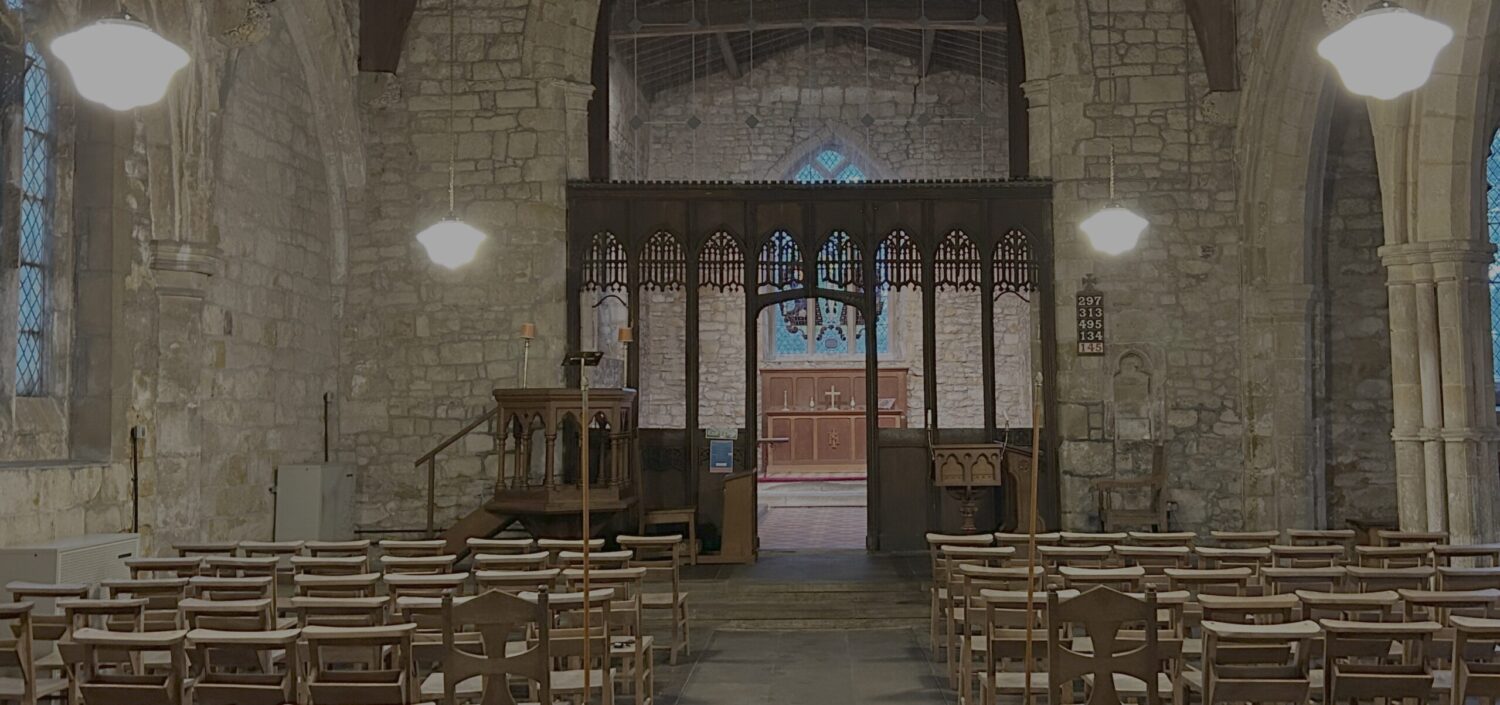
The church of St. Peter is a fascinating building, with a long and intricate story to tell.
The church of St Peter, Kirby Bellars, is a 13th Century Grade I listed parish church built alongside the former Augustinian priory, forming a unique example of a rural Leicestershire church building.
Constructed using golden ironstone, the tower is capped with an ashlar-broached spire, with lucerne set in all cardinal directions. The North Aisle was demolished under a licence in 1690, with the arcade still visible. The Nave dates to the early 13th Century. There are reused Saxon stone elements, and the stained-glass windows have 14th Century fragments in two of the Nave windows.
The church hosts alabaster effigies c.1360-70 of a knight and a woman; one of Sir Roger de Beler II (who gave his name to the village) with the lion rampant of his Arms on his breast, and one of his four wives.
The village is named in the Domesday Book as ‘Chirchebi’. During Edward II’s reign, Roger de Beler founded a college with a warden and twelve priests. In 1359, it was made conventual for a Prior and Canons of St Augustine’s order, lasting until the dissolution of the monasteries. The earthworks near the church are the remains of the former Priory.
In Nicholas Orme’s book Going to Church in Medieval England (2021), St Peter’s has multiple entries. In particular,
“A visitation of Lincoln Diocese in 1519 heard complaints from…Kirby Bellars in Leicestershire that ‘children there make a noise so it is hard to hear divine service’” (p.150).
“There were four kinds of unpopular in church. First there were the restless, who walked about even once the building was largely full of seats… Men in particular rise up and down or wander from altar to altar showing off their clothes or the hawk on their wrist, setting a bad example to the young. Next there were the gossips, male or female, who disturbed other people with their chatter. Kirby Bellars in Leicestershire had as many as five such men in 1518” (p.168-9).
The church is a major landmark in the Wreake valley, visible from the Leicester to Melton Mowbray road (A607) and the Salt Way, an ancient route running from Lincolnshire across to Barrow upon Soar, Leicestershire. The Church Architect describes St Peter’s as “archaeologically speaking one of the most fascinating churches I look after”.
St Peter’s is the custodian of a Quern stone, and there is a partial ancient stone cross in the churchyard. The river Wreake runs within the grounds. St Peter’s has achieved the EcoChurch bronze award, working towards Silver, further building our relationship with the environment.
St Peter’s has a full-circle six-bell ring, cast between 1614 and 1999.